Why FBM Is Worth a Second Look — Even If You Use FBA

There’s been a lot of discussion recently in the Amazon seller community about changes to the Buy Box algorithm that appear to be increasing visibility for merchant-fulfilled (FBM) offers.
That conversation felt like a good opportunity to pause and take a clear, honest look at FBM — not as a replacement for FBA, but as a powerful alternative that many sellers may be underutilizing.
To be clear up front: FBA is still a great selling model, and it will continue to be the preferred option for many sellers. But FBM has some meaningful advantages that are worth revisiting — especially in today’s fee-heavy, margin-sensitive environment.
Let’s start with fees — that familiar four-letter word Amazon sellers know all too well.
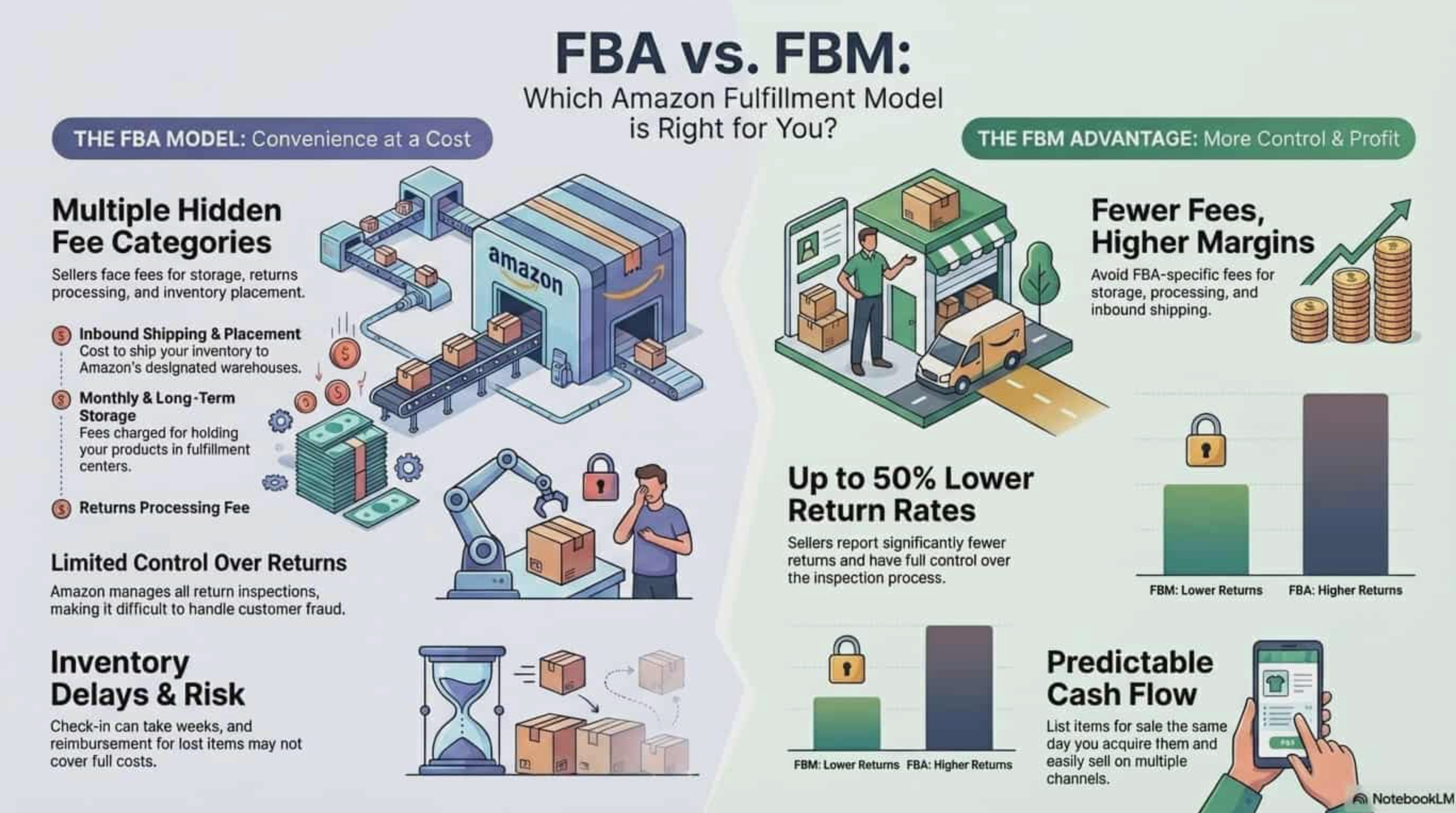
Many sellers don’t realize that there are entire fee categories that only apply to FBA, and if you sell FBM, you can avoid them altogether. These include:
When selling FBM, you keep your inventory and ship orders yourself, which eliminates many of these costs entirely. Depending on your category and volume, the difference can be substantial.
Returns are one of the less obvious — but most impactful — differences between FBA and FBM.
With FBA, when a customer returns an item, Amazon inspects it and decides whether it goes back into sellable inventory or is marked as “customer damaged.” If it’s deemed damaged, you must pay a removal order fee to get the item back. Sellers frequently report that Amazon rarely charges restocking fees in cases of customer abuse.
If you suspect abuse, you can open a reimbursement case — but many sellers find this process slow, inconsistent, and often unsuccessful.
With FBM, you have significantly more control:
Another trend many sellers observe is a lower overall return rate with FBM. While anecdotal, some sellers report reductions of up to 50% compared to FBA. If returns are a major issue in your category, this alone can materially impact profitability.
Amazon handles an enormous volume of inventory across its fulfillment centers. While the percentage of lost items may be small, it can still be meaningful at scale.
When Amazon loses FBA inventory, reimbursement is based on Amazon’s estimate of your product cost — which does not include expenses like inbound shipping, packaging, labeling, or prep. Sellers also report that Amazon’s cost estimates are often lower than actual costs.
To complicate matters further, Amazon reserves the right to claw back reimbursements if lost inventory later reappears — even years later.
For items lost during the FBA receiving process, sellers can request reimbursement, but should be prepared to provide detailed documentation and proof of shipment.
With FBM, inventory remains under your control, dramatically reducing these risks.
When you send inventory into Amazon fulfillment centers, the timeline for when items become available for sale can be unpredictable.
Sometimes items are available within days. Other times, it can take weeks — or longer — depending on how Amazon redistributes inventory within their fulfillment network or how busy they are at a given time.
During Q4, it’s not uncommon for inventory sent in November to become available after the holidays, which can significantly impact cash flow and inventory turns.
With FBM, you can list and sell items the same day you receive them. That immediacy brings predictability — and predictability improves cash flow.
Because you maintain possession of your inventory with FBM, you eliminate the lag time associated with shipping inventory to FBA.
This gives you:
For sellers operating across multiple platforms, FBM often provides the flexibility FBA cannot.
The short answer: organization.
Most sellers don’t lack effort or intelligence — they lack a system.
FBA is a system. It handles storage, picking, packing, and returns — but at a cost. FBM removes many of those costs, but requires structure to avoid chaos.
That’s where the right tools matter.
ScanLister was built to bring speed, structure, and accuracy to merchant-fulfilled selling.
It offers:
Lightning-fast listing
List products faster than using Seller Central directly. Less time listing = more time sourcing and selling.
Inventory management
Track every item. Know exactly when it was listed and exactly where it is stored.
Cost of goods & expense tracking
Capture costs instantly while listing. Your historical listing data is saved automatically for reporting and analysis.
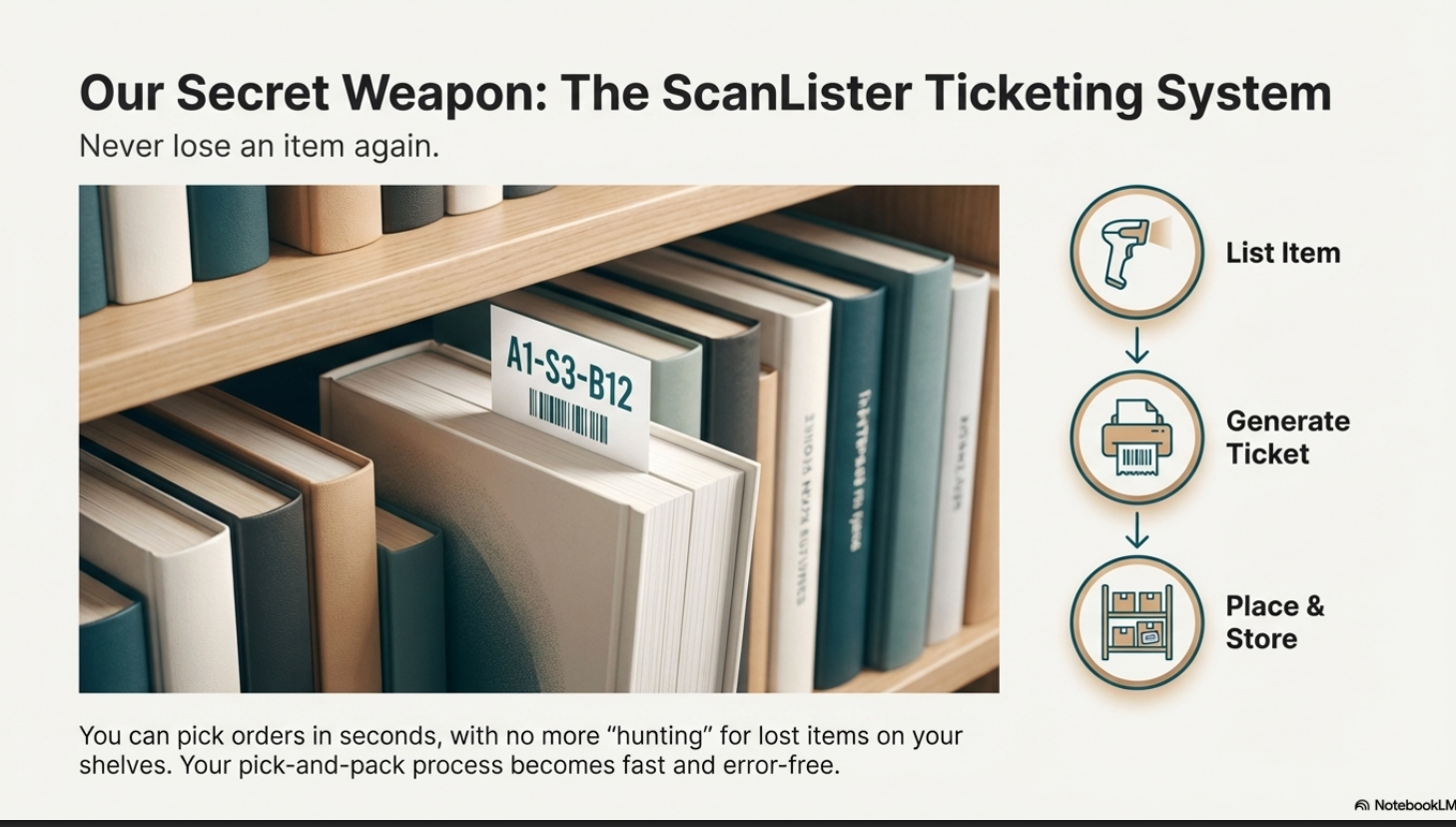
Never lose an item
When you list an item, ScanLister generates a custom ticket:
The result: orders can be picked in seconds, with no hunting or guesswork.
Audit with confidence
With a physical record and a structured system, inventory audits become straightforward. Print a report, walk the shelves, and verify stock instantly — eliminating ghost inventory and reducing cancellation risk.
Bottom line: Selling FBM can mean lower fees, fewer returns, more control, and better cash flow — even when selling at lower price points — if you have the right system in place.
By maintaining control of your inventory, you gain predictability and flexibility, while opening the door to multi-channel selling. ScanLister makes FBM listing fast, organized, and scalable — turning what many sellers see as chaos into a reliable, repeatable workflow.

